So you've decided to get started with rhinestoning? Fair warning: once you start, there's no turning back. It is incredibly satisfying and genuinely addicting!
When I first started bedazzling, I had so many questions and couldn't find all the answers I needed in one place. Through research, trial and error, and a lot of testing, I've learned everything I needed to master rhinestones, and this guide is everything I wish I'd had on day one.
Whether you want to bedazzle a tumbler, a t-shirt, a phone case, or a dance costume, this beginner's guide walks you through every step: the supplies, the techniques, the glues, and the questions I get asked most.

Are you ready to bling it on?
Bring your designs to life and let your creativity truly sparkle with our comprehensive rhinestone course.
Are you a beginner looking to learn how to work with rhinestones? This beginner's guide will walk you through the steps for applying rhinestones to various surfaces. From t-shirts to phone cases, when you finish reading, you'll be ready to bedazzling with rhinestones anything and everything!
What are rhinestones?
Rhinestones have been around for almost 300 years and have been used for clothing, crafts, and so much more. They are small, sparkly gems that come in a wide range of colors, shapes, and sizes, and are typically made from glass, crystal, or resin. You'll find them on jewelry, clothing, shoes, phone cases, and home decor.
The term "rhinestone" came from a river in Czechoslovakia called the Rhine. In the 18th century, a jeweler named George Friedrich Strass developed a method for creating high-quality imitation diamonds using leaded glass. Those glass gems became known as "strass stones" — and eventually "rhinestone" became the more widely used term.
Today, rhinestones are widely available and one of the most satisfying DIY materials to work with, beginner or not.
What are the types of rhinestones?
Yes, there are different types of rhinestones. Rhinestones come in various shapes, sizes, and materials, with their own unique characteristics and uses. In this beginner's guide, we will explore the different types of rhinestones and help you understand which ones are best suited for your projects.
Flatback Rhinestones
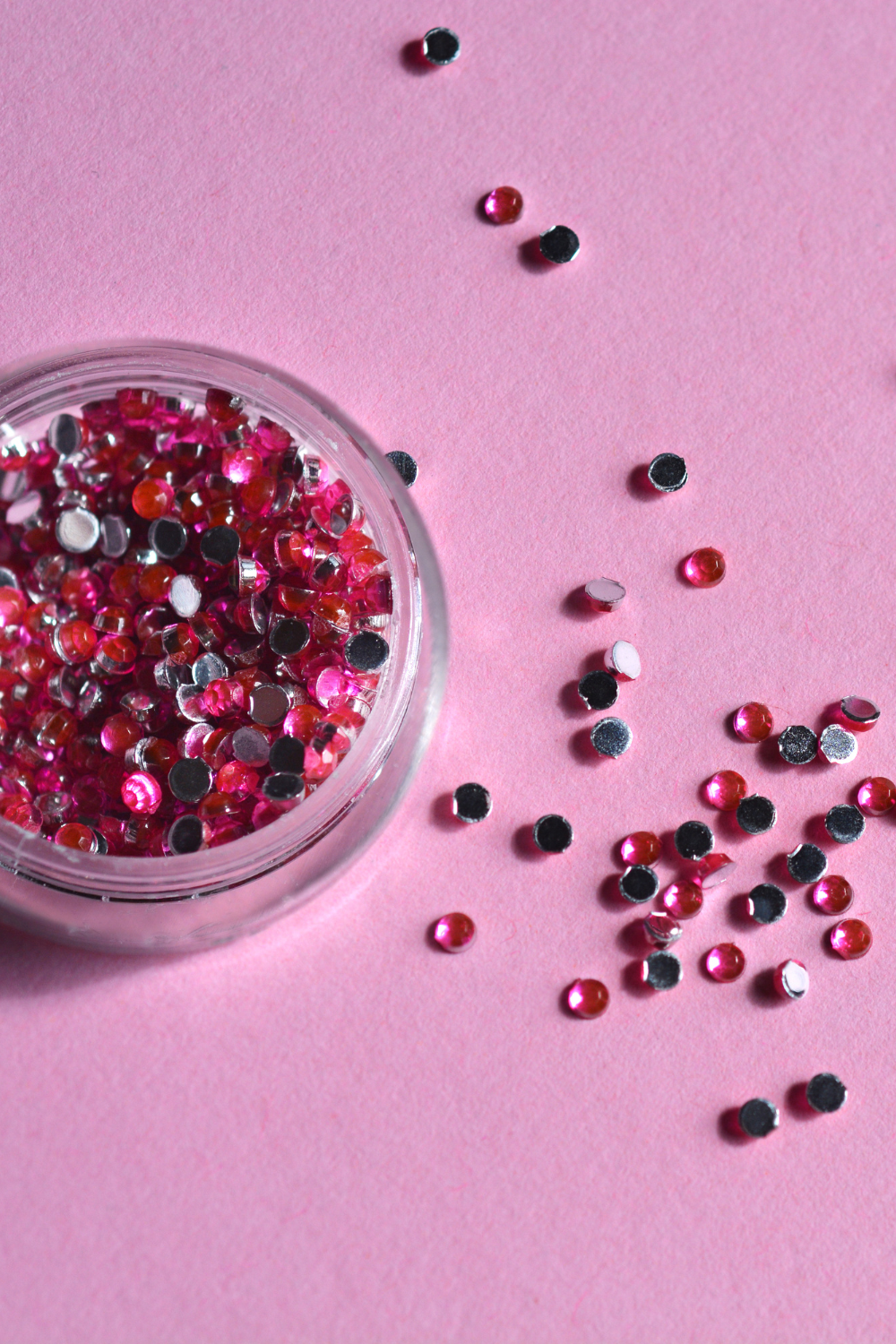
The most common type for crafting. They have a flat back that glues easily onto fabric, paper, plastic, and other surfaces. Available in a huge range of sizes and colors, these are a great starting point for beginners.
Hotfix Rhinestones
Unlike flatback rhinestones, hotfix rhinestones have a heat-activated adhesive on the back. You apply them with a heat press or hotfix tool instead of glue. Ideal for rhinestone t-shirts, dance costumes, and other fabric projects. They come in the same wide range of colors and sizes as flatbacks.
Sew-on Rhinestones
Sew-on rhinestones have holes on either side so they can be stitched onto fabric. Often used in garments and jewelry. They create a very secure hold and are great when the piece will get a lot of movement or wear.
Resin Rhinestones
Resin rhinestones are lightweight and often available in unique shapes. They have a slightly different look than glass or crystal rhinestones and work well for jewelry and crafts. They can be glued or sewn on.
Hotfix vs. Non-Hotfix Rhinestones
Remember, hotfix rhinestones have a heat-activated adhesive on the back, while non-hotfix rhinestones do not. Hotfix rhinestones are ideal for fabric-based projects, as they can be easily applied using a heat press or iron. Non-hotfix rhinestones require an adhesive such as glue or epoxy to be applied to surfaces.
| Type | Application | Best For |
|---|---|---|
| Flatback | Glue | Tumblers, phone cases, décor |
| Hotfix | Heat press / hotfix tool | T-shirts, costumes, fabric |
| Sew-on | Needle and thread | Garments, jewelry |
| Resin | Glue or sew | Jewelry, unique shapes |

What supplies do I need to get started?
Affiliate disclaimer: Although I stand by all of the products I use, I can receive a small commission from any products purchased via my affiliate links.
You don't need much to get started. Here's the short list:
Rhinestones — Start with flatback rhinestones in one or two sizes
Rhinestone glue — E6000 or Liquid Fusion for most surfaces
Wax pencil / picker pen — The single most important tool you'll buy
Rubbing alcohol — for surface prep
Sandpaper or sanding sponge — for prepping smooth surfaces
Rhinestone trays — to keep your stones organized while you work
Hotfix heat tool — only if you're working with hotfix rhinestones

Shop All My Faves
I love ordering supplies on Amazon because there are tons of selection results, free shipping (typically ships within a few business days) and it’s never final sale so if you change your mind, you can send the supplies back.
How to Apply Rhinestones
Method 1: Gluing (Flatback Rhinestones)
Clean and dry the surface. Remove any dust, oils, or residue.
Sand the surface lightly if it's smooth (like a tumbler) so the adhesive bonds better.
Apply a small dot of glue to the back of the rhinestone using a toothpick, pin, or precision tip bottle.
Place the rhinestone using your wax pencil.
Press down gently and allow to cure. Most glues take several days to a week to fully cure.
Method 2: Heat Press (Hotfix Rhinestones)
Position your hotfix rhinestones on the fabric.
Cover with a pressing cloth or Teflon sheet.
Press with your heat press for the manufacturer's recommended time.
Let cool before handling.
Method 3: Rhinestone Templates (for Custom Designs)
If you want a specific pattern or design, templates make this so much easier. You can buy rhinestone templates on Etsy or create your own using a Cricut and flock material. The template acts like a paint-by-number — place your rhinestones according to the pattern and secure them with adhesive.
I cover how to make your own Cricut templates in detail in my Bling It On course.
Method 4: Sewing (Sew-On Rhinestones)
Thread a needle with a color that matches your fabric or the stones. Sew each rhinestone through its holes and secure with a knot. This method is the most durable for garments that get regular movement. Don’t forget to secure the thread with knots to prevent the rhinestones from falling off!
Top Tips for Bedazzling With Rhinestones
There’s a reason Time magazine featured bedazzling as the activity with surprising mental health benefits! Here are a few tips that will help you eliminate the trial and error so you can find your zen and enjoy the process:
Your first line is everything. When doing a honeycomb pattern on a tumbler, take extra time getting the first row straight. Everything after that row depends on it.
The wax pencil is non-negotiable. Seriously. It changes the whole experience.
Less glue is more. If you're about to take a break, don't leave excess glue near your last row — it will prevent the next row from nestling in tightly.
Work in sections. On large projects, work in manageable areas so the adhesive doesn't dry before you've finished placing stones.
Start small. A phone case or greeting card is a great first project. Build your confidence before tackling a full tumbler.
Plan your design first. Sketch it out or use a template. Placing stones randomly is satisfying but having a plan gives cleaner results.
Use transfer tape for intricate designs. Apply the tape over the design, press down firmly, peel it off, and the rhinestones stick to the tape for easy transfer.
Prep your surface. Clean and dry — every time. Even fingerprint oils can affect adhesion.
Mark your lines. Use a marking pencil to draw guidelines before placing stones. A piece of painter's tape or a rhinestone belt also works well.
Keep extras on hand. Even with the best prep and adhesive, the occasional rhinestone will fall off over time.
Best Glues for Rhinestones (Glue Tips)
I've tested a lot of glues. Here are the tips that save the most frustration:
Fill precision tip bottles all the way up. Partially filled bottles make it harder to control flow.
Store bottles cap-on with a wet paper towel wrapped around the tip. This keeps the glue from drying out.
Sealed cap? Soak it in alcohol to release the dried glue.
Use a pin or thumbtack to apply glue as an alternative to toothpicks.
Less is always more. A tiny dot is all you need per stone.
E6000 and Liquid Fusion are my top two recommended adhesives for most surfaces. Keep in mind they take about a week to fully cure.
Avoid Mod Podge, polyurethane, or clear coat on top of rhinestones. All of these will make your rhinestones cloudy.
For a full breakdown of every glue I've tested, read my rhinestone glue guide here.
Are rhinestones suitable for all fabrics?
Rhinestones work on most fabrics, but some surfaces take them better than others.
Best fabrics:
Smooth, non-porous materials like satin and silk bond well with adhesive and reflect light beautifully.
More challenging fabrics:
Rough or highly textured surfaces like denim or burlap may not bond as evenly.
Delicate fabrics like chiffon or lace can sometimes be damaged or discolored by adhesive. Always do a test patch first.
Leather has a treated surface that makes adhesion trickier. E6000 can work but test first.
When in doubt, check the fabric care label or do a small test area before committing to the full design.

How to Store Rhinestones
Staying organized makes rhinestone work so much more enjoyable. Here's what works:
Compartmentalized storage boxes — The go-to choice. Clear containers let you see exactly what you have without opening everything.
Craft organizers with drawers — Great if you have a large collection and want to sort by size, color, or shape.
Clear rhinestone storage bags — Lightweight and portable, perfect for crafting on the go.
Bead trays — Stackable and spacious, great for organizing large quantities.
Magnetic sheets — A clever option if stones tend to spill or shift during work.
Keep rhinestones in a cool, dry place. Direct sunlight and humidity can weaken the adhesive coating and cause discoloration over time.
FAQs about Bedazzling with rhinestones
Since there's endless information out there; I thought I would start by answering the most frequently asked questions about working with rhinestones. These are the questions I am asked most often.
-
Glass rhinestones and Swarovski crystals sparkle a lot more than resin.
-
As for Swarovski crystals vs glass rhinestones? Back in the day when it was hard to find sparkly rhinestones, I would have said to go ahead and splurge on the Swarovski, but these days I cannot tell the difference between high quality glass rhinestones and Swarovski.
-
Glass rhinestones. I love these on Amazon and these on Be Createful. Use code ArtBeat on Be Createful for a discount.
-
I cover all of this in my course and also have this DIY tutorial with all of the details.
-
Honeycomb
Scatter
Linear
If you want to learn step by step how to do each of these, you'll love my rhinestones basics course!
-
The adhesives conversation is a long one and ever evolving as I discover new products. I have broken down my favorite glues based on testing, using and washing the rhinestones. Check that out here.
-
There are a few reasons why your rhinestones end up cloudy. The first is that you've used the wrong adhesive. Some adhesives result in cloudy stones which I've experienced first hand. Definitely test everything out on a scrap piece of metal before adhering to a tumbler. The second reason is that you've covered your rhinestones with adhesive. If you get glue on your rhinestones, be sure to clean them off immediately or remove them. The third reason is that you are using resin rhinestones. They aren't the same quality and some adhesives do not react well with resin.
-
No. Rhinestones do not need to be sealed. If you've used the right adhesive and prepped your surface, your rhinestones will stay. Sealing will take away the rhinestone's sparkle.
-
You can use something with a straight edge and press it against the bottom or top of the tumbler while the rhinestones are still wet (depending on which side you're working from). You can also buy guides that slide onto the tumbler.
-
In short, hotfix rhinestones are used with a heat press or a heat tool. Flat back are used with glue. There are also rhinestones that do not have a flat back, but I never use those kinds of rhinestones.
-
Check out patterns on Etsy. There are people who sell patterns which act as a paint by number - just keep a count and change the color according to the instructions on the template. Here is an example of a rhinestone pattern.
-
This is a whole topic in of itself but here are the basics. You can make your own designs using Inkscape and then import them into Cricut design space. The templates are reusable. The flock is on the pricey side, but you can use them again and again and again.
Learn the step by step process for making your own rhinestone templates using a Cricut in myBling it On digital rhinestone course!
-
There are several ways to keep your line straight. You can purchase levelers that wrap around a tumbler or you can do it by hand. To do it by hand, you'll need a marking pencil or marker. I prefer a pencil. Using a pencil, turn your tumbler around with the pencil touching the tumbler until you have a straight line across the bottom. Do this on a few other spots on your tumbler to ensure the lines remain neat and tight. You can use a piece of painter's tape or a rhinestone belt to achieve a straight line.
I personally love this tumbler holder - it comes with the belts, too. The most important thing when working with the honeycomb method is to get the first few lines straight. I also like to mark off lines periodically throughout the tumbler as a guideline while working. If the first line isn't straight, it is very challenging to be successful after that. Take a little bit more time on this first step to ensure that the entire design looks good!
-
Amazon, The rhinestone world, Transfer express
-
In my experience, Inkjoy pens work great when making pens. You do not need stainless steel pens - they're expensive and not necessary. Simply sand off the grip coating on the ink joy and start adding rhinestones.
-
If you spend a lot of time working with rhinestones, eventually you are going to have an achy neck. I find using an adjustable desk or chair works well. Leaning over and looking down for hours will cause neck pain. Try to work at eye level or close by. I like these tumbler mounts on Amazon. As for eye strain, use magnifying glasses and a good light. I like these jewelers glasses - I used them during my jewelry making days and they are amazing. I use three lights when rhinestoning. I have the regular ceiling lights, a bright lamp and direct light. The only downside? Sometimes it gets hot!
-
Yes! It is very easy to make a template on a Cricut Machine or any vinyl cutting machine. Check out my class;Bling it on, for more details!
-
Soak your cloudy rhinestones in acetone or rubbing alcohol for several hours to remove glue. Use a gentle cloth on the top of the rhinestone. This isn't foolproof but usually works really well!
-
AB stands for Aurora Borealis. They are named after the Northern Lights. Clear rhinestones are transparent but still faceted. Crystal are silver with silver coating. Anything AB adds an iridescent finish. This is all personal preference.
-
Foiled rhinestones have foil on the bottom and unfoiled do not.
-
I wrote an entire glue guide here, but below are the questions I get most.
-
E6000 works well on many surfaces. Leather or a surface with oils are sometime hard to use with E6000. Also, E6000 is pretty toxic, so be mindful of that.
-
E6000 or Liquid Fusion worked best for me. However, this depends on the fabric. Leather, for example, is harder to apply rhinestones or a rhinestone appliqué to because it has a treated surface.
-
These are two adhesives that look pretty similar. The main difference is that B7000 is more flexible. For flat, non porous surfaces, B6000 will perform better. Just be sure to work in a well ventilated space.
-
The adhesives conversation is a long one and ever evolving as I discover new products. I have broken down my favorite glues based on testing, using and washing the rhinestones. Check that out here.
-
In my experience, using Elmer's glue for rhinestones is best when working with kids. It doesn't last forever. If you do not want to use E6000 or Liquid Fusion, Aileene's would work better than Elmer's. However, neither Elmer's or Aileene's will have the same permanence as the Liquid Fusion.
-
You only need a UV light if you are using UV resin to adhere rhinestones. This is commonly used in nail salons. Just know that if you are using UV resin or adhesive, you will need a well ventilated space. UV fumes are not good to breathe in.
-
No. Do not do this. It will make your rhinestones cloudy.
-
No. Do not do this. It will make your rhinestones cloudy.
-
You do not need a protective coating. With the right prep and right adhesive, you won't need anything else.
-
No. Do not do this. It will make your rhinestones cloudy.
-
Yes. But do not put in wash machine or dishwasher. Dish soap like dawn is fine for cleaning tumblers.
-
You don't. Glue is more than enough.
-
Yes, it takes about a week for E6000 and Liquid Fusion to fully cure.
-
No. But do not put in wash machine or dishwasher. Dish soap like dawn is fine for cleaning tumblers.
-
Either you didn't prep the surface, used the wrong adhesive or didn't push down hard enough. Other than that, you should never put rhinestones in the dishwasher or wash machine. Even under the best circumstances, rhinestones occasionally do fall off so keep extras on hand.
-
Yes. Use dawn dish soap and a soft brush. Hand wash only and do not put in the dishwasher.
-
By hand. And hang dry.
-
Yes. In my experience, when you use the right glue, they can stay on but you will eventually lose a few - do not put into the wash or the dryer.
-
I have not seen rhinestones tarnish. If you use pronged rhinestones, tarnish is possible.
-
Yes. Hand wash only to maximize the strength of the adhesive.
-
Most glues dry quickly but do not full cure for at least a few days to a week.
-
Stone count may vary depending on the complexity of your design. For a 24 ounce Starbucks Cup (acrylic clear), you will need approximately 3000-3100 SS10 Rhinestones.
-
A very long time!
-
No, they lose their sparkle.